Dubai Metro Gold Line 2026: Key Facts, Routes & Benefits
 sacscreativemedia

Dubai Metro Gold Line is one of the most important transport projects announced in Dubai in 2026. Designed to improve connectivity between established districts and fast-growing communities, the new metro route is expected to influence daily travel, business activity, residential demand, and long-term property investment across several parts of the city.
Dubai has built a reputation for investing in modern infrastructure, and the Gold Line is another major step in that direction. The planned route will stretch approximately 42 kilometres and include 18 stations across 15 strategic areas. The project is expected to connect around 55 major real estate developments and create stronger links between older parts of Dubai and emerging communities.
For residents, businesses, and property buyers, the project raises an important question: What will the Gold Line actually change for Dubai? This guide explains the planned route, stations, expected timeline, key interchanges, benefits, and potential impact on the property market.
The Dubai Metro Gold Line is a planned 42-kilometre metro corridor designed to expand Dubai’s rail network and improve connections between several major residential, commercial, and investment areas.
The project was announced in April 2026 as part of Dubai’s long-term transport and urban development plans. It is expected to be the city’s first fully underground metro line, with parts of the route reaching depths of up to around 40 metres. The project has been valued at approximately AED 34 billion.
Unlike a route designed to serve only established commercial centres, the Gold Line is planned to connect a mixture of mature districts and future growth areas. This makes it particularly interesting for people who are considering where to live, work, rent, or invest in Dubai over the longer term.
The planned opening date is 9 September 2032, meaning the project is a long-term infrastructure development rather than a metro line that residents can use immediately.
Here are the main details currently available:
| Feature | Planned Details |
|---|---|
| Route length | Approximately 42 km |
| Number of stations | 18 |
| Strategic areas served | 15 |
| Project value | Approximately AED 34 billion |
| Planned opening | 9 September 2032 |
| Underground route | Fully underground |
| Major developments connected | Around 55 |
| Main route | Al Ghubaiba to Jumeirah Golf Estates |
| Future rail connection | Etihad Rail integration |
| Announcement | April 2026 |
The exact station-by-station locations may continue to develop as planning and project execution progress. Therefore, buyers and residents should distinguish between confirmed route information and early maps or unofficial station predictions.
One of the biggest reasons the project has attracted attention is its planned route through a combination of established and emerging locations.
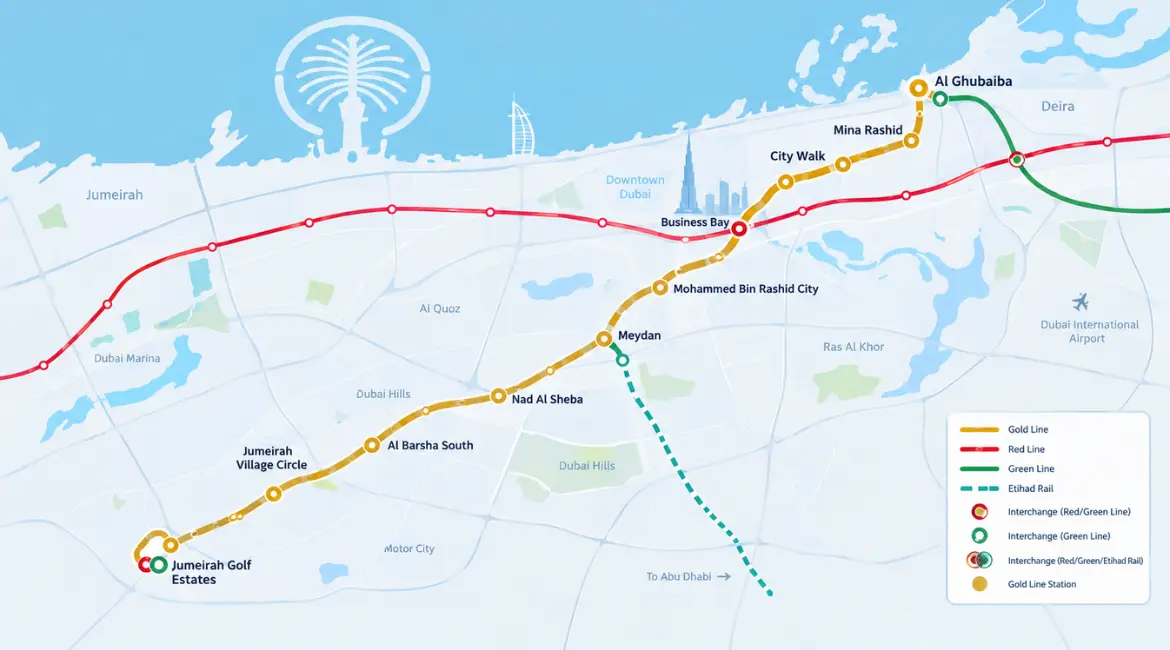
The line is planned to start around Al Ghubaiba and extend towards Jumeirah Golf Estates. Along the wider corridor, it is expected to improve connections to areas including Bur Dubai, Al Satwa, Business Bay, Meydan, Al Barsha South, Jumeirah Village Triangle, Dubai Production City, and Jumeirah Golf Estates.
However, it is important to understand that not every area mentioned in early route descriptions necessarily represents a confirmed station location. The government-released route plan provides the broader corridor, while detailed station information can become clearer as the project moves forward.
For property buyers, this distinction matters. A property being described as “near the Gold Line” does not automatically mean it will be directly beside a future station.
Connectivity with Dubai’s existing transport network is another major advantage of the planned route.
The Gold Line is expected to provide interchange opportunities with the existing metro system at important locations. Planned connections include:
● Al Ghubaiba, connecting with the Green Line
● BurJuman, providing connections with the Red and Green lines
● Business Bay, connecting with the Red Line
● Jumeirah Golf Estates, where future integration with Etihad Rail is planned
These connections could make the route more useful than a standalone metro corridor because passengers may be able to move between different parts of Dubai without depending entirely on private vehicles.
For commuters, this could make cross-city journeys easier. For businesses, stronger public transport access can improve employee and customer accessibility. For property owners, improved connectivity may become another factor when tenants compare communities.
Dubai’s population, residential communities, commercial districts, and economic activity continue to expand. Transport infrastructure therefore needs to grow alongside the city.
The new line is designed to support this expansion by connecting areas that have historically depended more heavily on road transport.
The project also supports Dubai’s wider objective of creating a highly connected and efficient urban environment. By linking established districts with future development zones, the metro can support more balanced growth rather than concentrating movement around a limited number of central areas.
The project is also expected to support major real estate developments along its corridor. Government and industry reporting has highlighted connections to approximately 55 major developments, making transport planning and property development closely connected in this project.
The most obvious benefit is improved public transport access.
For people who live close to future stations, daily journeys could become easier and more predictable. Instead of relying entirely on driving, residents may have another option for reaching business districts, shopping areas, leisure destinations, and other communities.
The planned route connects several parts of Dubai that currently have different levels of metro access. This can make public transportation more practical for residents who live outside the existing core metro corridors.
A reliable metro connection can reduce dependence on cars for certain journeys. This can be particularly useful for employees travelling to major business districts.
New residential communities can become more attractive when transport infrastructure improves. Better connectivity can support the growth of shops, offices, schools, hospitality businesses, and other services.
The route is significant because it is planned to connect historic parts of Dubai with newer development areas. This can create better movement across the city rather than focusing transportation around a few established locations.
Transport infrastructure and property markets often influence each other. When accessibility improves, a location can become more attractive to residents, tenants, businesses, and investors.
The potential property impact of the Gold Line should therefore be considered over the long term rather than as a promise of immediate price increases.
Properties located within convenient reach of future metro stations could benefit from stronger tenant interest if the stations eventually become operational. Rental demand may also improve in communities where residents value easy access to public transportation.
However, investors should avoid buying a property simply because a future metro line is planned nearby. Location quality, developer reputation, building quality, service charges, rental demand, supply levels, and current accessibility remain important.
Future infrastructure is an advantage, but it should be treated as one part of a wider investment analysis.
Several communities could benefit from the Dubai Metro Gold Line project as Dubai continues to expand its transport network. Improved connectivity could support residential demand, rental activity, and long-term investment interest in selected areas.
Jumeirah Village Circle (JVC) could be one of the most closely watched communities because it is already popular with renters and investors but has historically relied heavily on road access. A future metro connection could improve convenience for residents, increase its appeal to tenants, and support long-term demand.
Meydan and Mohammed Bin Rashid City (MBR City) are major growth areas with a significant pipeline of residential and mixed-use developments. Improved connectivity could support end-user demand and investor confidence, particularly for properties in well-connected locations with strong community amenities.
Business Bay already benefits from strong transport connectivity and access to the existing metro network. An additional connection could make the area even more attractive to professionals, residents, and companies. Better accessibility may also support rental demand and long-term property liquidity.
Mina Rashid could benefit from stronger transport access as the waterfront community continues to develop. Improved connectivity may help link the area more effectively with Old Dubai and other central districts, potentially making it more attractive to residents and investors seeking a waterfront lifestyle with convenient city access.
Jumeirah Golf Estates is an established premium residential community known for its spacious homes and lifestyle-focused environment. A future Dubai Metro Gold Line connection, together with planned Etihad Rail integration, could improve accessibility and strengthen its appeal to buyers looking for space, lifestyle, and better transport options.
It could create interesting long-term opportunities, but investors should take a balanced approach.
A future metro station can potentially improve the attractiveness of a property because tenants often value convenience. Properties in well-connected areas can also appeal to a broader pool of potential tenants and buyers.
However, infrastructure-led investment requires patience. The planned opening is in 2032, so investors should consider whether a property makes sense based on its current fundamentals rather than relying only on future appreciation.
Before purchasing, investors should examine:
● Current rental demand
● Expected rental yield
● Property purchase price
● Service charges
● Developer track record
● Community amenities
● Current road accessibility
● Distance to planned transport links
● Existing and future property supply
● Exit and resale potential
If you are comparing properties based on future infrastructure, working with a Best Real Estate Broker in Dubai can help you evaluate the wider market rather than focusing on one future development.
Tenants may also benefit from improved transport choices.
A future metro station can make some residential communities more appealing to people who commute regularly and prefer not to drive every day.
For example, a tenant working in a central business district may be willing to consider a community farther from the workplace if public transport provides a convenient connection.
This could gradually expand the rental market beyond traditional high-demand areas.
Landlords should also consider this when planning their long-term property strategy. A property that has good access to future infrastructure may become more competitive, but rental pricing will still depend on the overall supply and demand in the community.
Dubai already has an established metro system, including the Red and Green lines, while the Blue Line is also part of the city’s wider rail expansion programme.
The Gold Line is different because its planned corridor is intended to connect several strategic areas that are not currently served by direct metro access.
Its fully underground design and planned connections to existing lines could help create a more integrated network.
Rather than viewing the Gold Line as a replacement for the existing metro, it is better understood as an expansion of Dubai’s overall public transport system.
The planned opening date is 9 September 2032.
This is important for anyone considering property investment based on the project. The benefits associated with actual metro operations are still several years away.
During the development period, route planning, station design, construction, and other project details may progress. Investors should therefore monitor official announcements instead of relying entirely on social media posts or unofficial maps.
The project was announced in April 2026, with a planned 42-kilometre route, 18 stations, and a total project value of approximately AED 34 billion.
Future infrastructure can be attractive, but it should never be the only reason to purchase a property.
A sensible buyer should first assess the property itself.
Ask whether the community has strong demand today. Check how easy it is to reach major roads and existing public transport. Review the quality of nearby schools, shops, parks, healthcare facilities, and other amenities.
For investors, compare the expected rental income with the purchase price and ongoing ownership costs.
It is also useful to look at the development timeline. A property expected to benefit from a metro line in several years may suit a long-term investor, but it may not be appropriate for someone who needs immediate transport access.
This approach helps separate genuine long-term opportunities from properties being marketed mainly around future infrastructure.
The planned metro connection can make certain locations more interesting, but buying an off-plan property should involve much more than looking at a future station on a map. Investors should assess whether the development has the right fundamentals to remain attractive before and after the infrastructure is completed.
For buyers considering off-plan properties in Dubai, proximity to a planned metro station can be an added advantage. However, the exact distance, ease of access, surrounding roads, community facilities, and expected connectivity should all be considered. A property that is technically close to the route may not offer the same benefit as one with convenient pedestrian or road access to a future station.
The developer behind the project is one of the most important factors to consider. Buyers should review the developer’s previous projects, delivery record, construction quality, and reputation before making a commitment.
The development itself should also offer practical layouts, useful amenities, good building standards, and features that appeal to the target market. These factors can continue to influence demand even if infrastructure plans change.
Payment structures can vary significantly between off-plan projects in Dubai. Buyers should understand the full payment schedule, booking requirements, registration costs, service charges, and other expenses before committing.
A flexible payment plan may improve cash-flow management, but it should not be the main reason for choosing a property. The overall purchase price should still make sense when compared with similar developments in the area.
The relationship between the property’s expected handover date and the metro project’s planned completion is another factor worth considering.
A project handed over several years before the metro becomes operational will need to attract residents and tenants based on its existing location and amenities. On the other hand, a development scheduled closer to the planned metro opening may have a stronger future connectivity story when it reaches completion.
However, investors should avoid paying a large premium today based solely on infrastructure that is still years away.
Think about who is likely to rent or buy the property in the future. Young professionals, families, and commuters may place a higher value on convenient access to public transport.
At the same time, rental demand will depend on more than the metro. Community lifestyle, nearby schools and retail options, property quality, rental pricing, and competing supply will all influence performance.
The best opportunity is usually a property that has strong demand on its own, with future metro connectivity providing an additional advantage rather than being the entire investment case.
The planned Dubai Metro Gold Line represents a major step in Dubai’s long-term transport expansion. With approximately 42 kilometres of track, 18 planned stations, connections across 15 strategic areas, and links to existing metro lines and future rail infrastructure, the project could reshape how people move between several important parts of the city.
For residents, the biggest potential benefit is better connectivity. For businesses, it could improve access to employees and customers. For landlords and investors, future transport access may create additional opportunities in selected communities.
At the same time, buyers should remain realistic. The planned opening is in 2032, so the best investment decisions should be based on both today’s property fundamentals and tomorrow’s infrastructure opportunities.
As Dubai continues to expand, transport and real estate will remain closely connected. Understanding where major infrastructure is planned can help buyers, tenants, landlords, and investors make better-informed decisions without relying on speculation.
For anyone considering property in areas expected to benefit from future connectivity, the smartest approach is to evaluate the complete picture: location, price, rental demand, amenities, developer quality, current accessibility, and long-term infrastructure plans.